
Introduction
In modern plywood manufacturing plants, veneer drying is one of the most critical processes affecting final plywood quality.
After veneer peeling, freshly produced wood veneers usually contain high moisture content. Before gluing and hot pressing, veneers must be dried to achieve suitable moisture levels and ensure strong bonding performance.
A stable and efficient veneer drying system depends not only on the dryer structure and heating system but also on the quality of its conveyor components.
Among all veneer dryer machine parts, the Teflon mesh belt plays an important role in continuous veneer transportation, heat transfer efficiency, and production stability.
A low-quality conveyor belt may result in:
- Uneven veneer drying
- Material deformation
- Production interruptions
- Higher maintenance costs
- Reduced plywood quality
For plywood manufacturers, selecting a durable and suitable Teflon mesh belt for veneer dryer machines is essential for maintaining long-term production efficiency.
1. What Is a Teflon Mesh Belt?
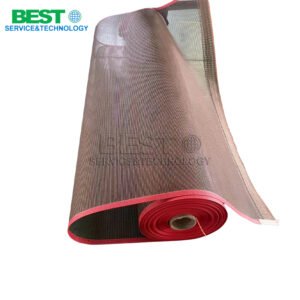
A Teflon mesh belt is a high-performance conveyor belt manufactured using fiberglass mesh fabric coated with PTFE (Polytetrafluoroethylene), commonly known as Teflon.
It is widely used in industrial drying systems because of its excellent resistance to:
- High temperatures
- Chemical corrosion
- Moisture
- Continuous friction
In veneer dryer applications, the Teflon mesh belt transports wood veneers through heated drying chambers while maintaining stable movement and airflow circulation.
2. The Role of Teflon Mesh Belt in Veneer Dryer Machines
The veneer dryer conveyor system must operate continuously under high-temperature working conditions.
The Teflon mesh belt performs several important functions.
2.1 Stable Veneer Transportation
During the drying process, veneers are thin and easily affected by mechanical pressure.
A high-quality mesh belt provides:
- Smooth transportation
- Reduced veneer damage
- Stable feeding speed
- Accurate positioning
This helps prevent:
- Veneer overlapping
- Material blocking
- Production delays
For large plywood factories, stable transportation directly affects daily production capacity.
2.2 Improve Drying Efficiency
The mesh structure allows hot air to pass through the veneer surface from multiple directions.
Compared with traditional solid conveyor belts, Teflon mesh belts provide:
- Better air circulation
- Faster moisture removal
- More uniform drying results
This improves overall energy efficiency and reduces drying time.
2.3 High Temperature Resistance
Veneer dryer machines usually operate under continuous high temperatures.
Common operating conditions include:
- Long working hours
- Continuous heating cycles
- High humidity environments
Ordinary conveyor materials may become:
- Soft
- Deformed
- Cracked
- Aging quickly
Teflon-coated fiberglass mesh belts can maintain stable performance under high-temperature environments, making them suitable for industrial veneer drying systems.
3. Advantages of Using Teflon Mesh Belt for Veneer Dryer Machines
3.1 Excellent Heat Resistance
One of the biggest advantages of Teflon mesh belts is their ability to withstand high temperatures.
Benefits include:
- Longer service life
- Reduced replacement frequency
- Stable production performance
For plywood manufacturers operating multiple shifts, durable conveyor components reduce unexpected downtime.
3.2 Non-Stick Surface Performance
Wood veneer contains natural resin, moisture, and other organic materials.
During drying, some materials may stick to conveyor surfaces.
The smooth PTFE coating provides:
- Low friction surface
- Easy cleaning
- Reduced material adhesion
This helps maintain clean production conditions.
3.3 Corrosion and Chemical Resistance
Industrial plywood production environments may contain:
- Wood dust
- Glue chemicals
- Moisture
- Cleaning agents
Teflon coating provides excellent chemical resistance, helping protect the belt from environmental damage.
3.4 Long Service Life
Compared with conventional conveyor materials, Teflon mesh belts offer:
- Better durability
- Higher temperature stability
- Lower maintenance requirements
Although the initial investment may be higher, the long-term operating cost is usually lower.
4. How to Choose the Right Teflon Mesh Belt for Veneer Dryer Machines
Selecting the correct belt specification is important for ensuring compatibility.
Important factors include:
4.1 Mesh Opening Size
Different veneer drying systems require different mesh structures.
Common considerations:
- Veneer thickness
- Airflow requirements
- Dryer design
- Production speed
A suitable mesh opening improves drying efficiency.
4.2 Belt Width
The belt width should match the dryer conveyor structure.
Common industrial requirements include:
- Machine width
- Veneer size
- Production capacity
Incorrect belt width may cause:
- Edge damage
- Uneven transportation
- Installation problems
4.3 Temperature Resistance
Different production environments require different temperature grades.
Manufacturers should confirm:
- Dryer operating temperature
- Continuous working time
- Heating system design
4.4 Connection Method
Industrial Teflon mesh belts usually use different joining methods:
- Spiral connection
- Stainless steel clip connection
- Endless belt connection
The correct connection method ensures smooth operation and easy installation.
5. Common Problems Caused by Poor Quality Dryer Conveyor Belts
Using unsuitable conveyor belts may create several production problems.
Uneven Veneer Drying
Poor airflow circulation can cause:
- Different moisture levels
- Uneven board quality
- Glue bonding problems
Frequent Belt Replacement
Low-quality belts may suffer from:
- Surface damage
- Cracking
- Stretching
- Deformation
This increases maintenance costs.
Production Downtime
A damaged conveyor belt may stop the entire veneer drying process.
For plywood factories, unexpected downtime can cause:
- Production delays
- Increased labor costs
- Delivery problems
6. Maintenance Guide for Teflon Mesh Belt
Proper maintenance can significantly extend belt service life.
Regular Cleaning
Remove:
- Wood dust
- Glue residue
- Foreign materials
Regular cleaning improves belt performance.
Check Belt Tension
Incorrect tension may cause:
- Belt deviation
- Uneven operation
- Excessive wear
Operators should regularly inspect conveyor tension.
Inspect Belt Surface
Check for:
- Broken mesh
- Damaged coating
- Connection problems
Early inspection prevents major failures.
Maintain Conveyor Rollers
The belt performance also depends on:
- Roller alignment
- Bearing condition
- Drive system
A damaged roller can accelerate belt wear.
7. Why Choose Professional Veneer Dryer Machine Parts Suppliers?
For international plywood manufacturers, purchasing spare parts from professional suppliers provides several advantages:
Accurate Product Matching
Experienced suppliers can recommend:
- Correct belt specifications
- Suitable materials
- Compatible designs
Quality Control
Professional suppliers usually provide:
- Material inspection
- Size verification
- Production quality control
International Export Experience
A reliable supplier should understand:
- Export packaging requirements
- International shipping
- Customer technical requirements
8. Applications of Teflon Mesh Belt in Wood Processing Industry
Teflon mesh belts are commonly used in:
- Veneer dryer machines
- Plywood production lines
- Wood panel drying systems
- Industrial continuous drying equipment
They are especially suitable for factories producing:
- Commercial plywood
- Film faced plywood
- Furniture plywood
- Decorative panels
Conclusion
The Teflon mesh belt is a key component of modern veneer dryer machines.
Although it may appear to be a simple conveyor component, its performance directly affects:
- Veneer drying quality
- Production efficiency
- Machine reliability
- Operating costs
For plywood manufacturers, choosing high-quality veneer dryer machine parts is an important investment in long-term production stability.
BS Wood Machine Spare provides professional spare parts solutions for plywood manufacturing plants worldwide, including veneer dryer conveyor belts, hot press machine components, veneer peeling machine parts, and other woodworking machinery accessories.
Need Reliable Veneer Dryer Machine Parts?
BS Wood Machine Spare provides professional spare parts solutions for plywood factories worldwide.
We supply:
✓ Teflon mesh belts for veneer dryer machines
✓ Veneer peeling machine parts
✓ Hot press machine components
✓ Glue spreader machine rollers
✓ Customized plywood machinery spare parts
Contact our technical team today for product recommendations and quotation.
Categories
Recent Posts
Need Plywood Machinery Spare Parts?
Get professional solution for your production line.
Frequently Asked Questions (FAQ)
The service life depends on:
- Working temperature
- Production hours
- Maintenance condition
- Belt quality
Proper maintenance can significantly extend operating life.
Yes.
Professional suppliers can customize:
- Width
- Length
- Mesh opening
- Connection type
According to different veneer dryer machine designs.
Common reasons include:
- Incorrect tension
- Poor belt quality
- Roller misalignment
- Excessive operating temperature
Checking the complete conveyor system is recommended.
Yes.
Because of their high temperature resistance and durability, Teflon mesh belts are widely used in continuous industrial veneer drying operations.
Related Articles
Related Video
Related Products
Need Reliable Plywood Machinery Spare Parts?
BS Wood Machine Spare provides high-quality spare parts and professional solutions for plywood factories worldwide.